
Rubber Expansion Joints & Metal Flexible Compensators
Engineered for demanding industrial pipework, our rubber expansion joints and flexible metal compensators absorb vibration, thermal expansion and pipeline movement — protecting critical equipment from stress and premature failure.
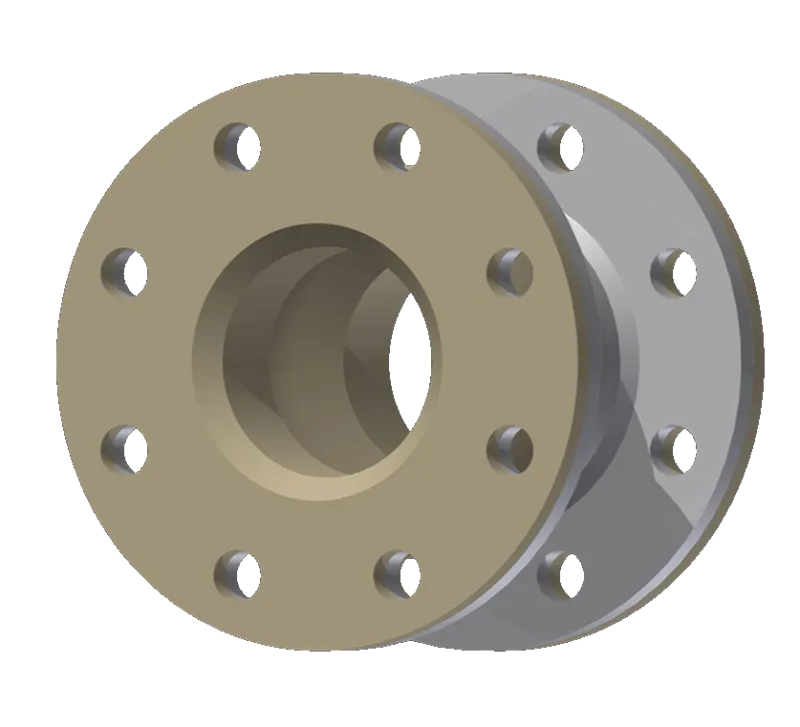
Why Are Expansion Joints Necessary?
A pipeline never stays as still as the drawing suggests. It heats and grows, cools and contracts; it carries pump and compressor vibration; it drifts off axis as the ground settles. When those movements are restrained, the resulting force loads the weakest point — usually a pump flange, a tank nozzle or a valve body.
An expansion joint takes that movement onto itself and releases the line. It is a small component; the equipment it protects is worth many times more.
Three Types of Movement at Once
- Axial: extension and compression from thermal growth.
- Lateral: parallel offset between pipe axes.
- Angular: small angular deflection of the line.
On top of that they provide vibration and noise isolation: vibration from rotating equipment is not transmitted into the pipework and from there into the structure.
Rubber or Metal Bellows?
Rubber Expansion Joints
An elastomer body is superior at damping vibration and can absorb all movement types simultaneously. Installation is straightforward and noise is cut at source. Its limits are temperature and chemical compatibility: the elastomer compound is selected against the medium.
Flexible Metal Compensators
A stainless steel bellows is used at high temperature and pressure, or with media no elastomer would survive. It is the answer on steam, exhaust and flue gas lines; vibration damping is not as good as rubber, but the temperature range is far wider.
Hygienic Applications: Ditec U110A FDA
On food, beverage, pharmaceutical and biotechnology lines there is a second requirement: leaving no dead space. A conventional joint with seams and cavities can trap product and create conditions for bacterial growth.
The Ditec U110A FDA in our catalogue removes that problem with a seamless, dead-space-free interior: it is individually moulded from FDA and EU 1935/2004 compliant elastomers, provides a gasket-free connection through full-faced rubber flanges, and supports CIP/SIP cleaning protocols.
Information Needed for Selection
| Information | Why |
|---|---|
| Medium and temperature | Rubber or metal; elastomer compound |
| Operating and peak pressure | Reinforcement layers, vacuum rating |
| Expected movement (mm) | Axial/lateral/angular capacity |
| Connection type | Flange standard, sleeve end or Tri-Clamp |
| Nominal diameter and length | Installation gap and body dimensions |
The Most Common Installation Mistake
An expansion joint must not be used to correct a pipework alignment error. Forcing two misaligned flanges together leaves the joint pre-stressed from the moment of installation and shortens its life considerably. Fixed anchors and guides must also be used where required so that movement capacity is never exceeded.
Share your line data and we will define the right type, material and connection together. Accessories including backing flanges, clamping systems and protective covers are supplied as well.